Modern medicine often prides itself on progress, yet its foundations are tainted by a history that continues to shape the experiences of Black patients today. Medical racism, especially when it comes to women’s health, didn’t emerge in a vacuum. It was built on the bodies of enslaved Black women whose forced “contributions” to gynaecology were justified by a racist myth that Black people do not feel pain. This belief - born out of violence and pseudoscience - not only enabled brutal experimentation in the past but still echoes through contemporary healthcare, where Black women are more likely to have their symptoms dismissed, their pain minimised, and their lives endangered. Understanding this history is not optional; it is essential to confronting the inequities that persist in medical practice today.
The news recently has had an influx of stories of Black women being turned away during active labour and not believed when they say something is wrong. Most notably, the story of Adriana Smith, a Black woman in Georgia, who was forced to carry her baby to term despite being brain-dead due to the state's draconian abortion laws. The hospital was legally obliged to keep her on life support when this decision should have fallen to the family. The fact that she was pregnant at the time meant she was kept almost as an incubator for the child. This complex situation meant her child was delivered prematurely from her dead body, and the baby has been facing serious health complications and fighting for his life in the neonatal intensive care unit (NICU). This case is a modern example of the systemic discrimination and malpractice Black women face in the medical system. The reasons for this date back hundreds of years, and I will unpack this painful history in this article.
In order to understand the reasons for modern medical racism, we must first go back in time to the period of transatlantic slavery, starting in the early 1500s and ending in the 1860s. This period, spanning almost 400 years, had a deep impact on the lives of people of African descent in all aspects of society and still shapes race relations today.
Professor of History and Medicine Deirdre Cooper Owens stated that when the US Constitution banned international slavery in 1865, an issue arose: How was the US going to maintain and grow this lucrative system of slavery if the import of Black bodies was now illegal? The answer was frighteningly obvious. Already enslaved Black women would become the means of production for the need of an unpaid workforce, as chattel slavery was a condition passed from mother to child. This new focus on the ‘natural increase’ of the enslaved population meant that Black women’s fertility and ensuring their children lived to a workable age was now the business of the state and tied to economic success.
This increased pressure on Black women to reproduce led to a renewed interest in gynaecology. This was to ensure enslaved women could give birth to as many children as possible with as few complications as possible. ‘Modern Gynaecology’ advanced rapidly in the South, and many of the doctors were slave owners themselves, which meant they had plenty of black female bodies at their disposal for experimentation.
James Marion Sims, 1813-1880, is often hailed as the father of modern gynaecology.
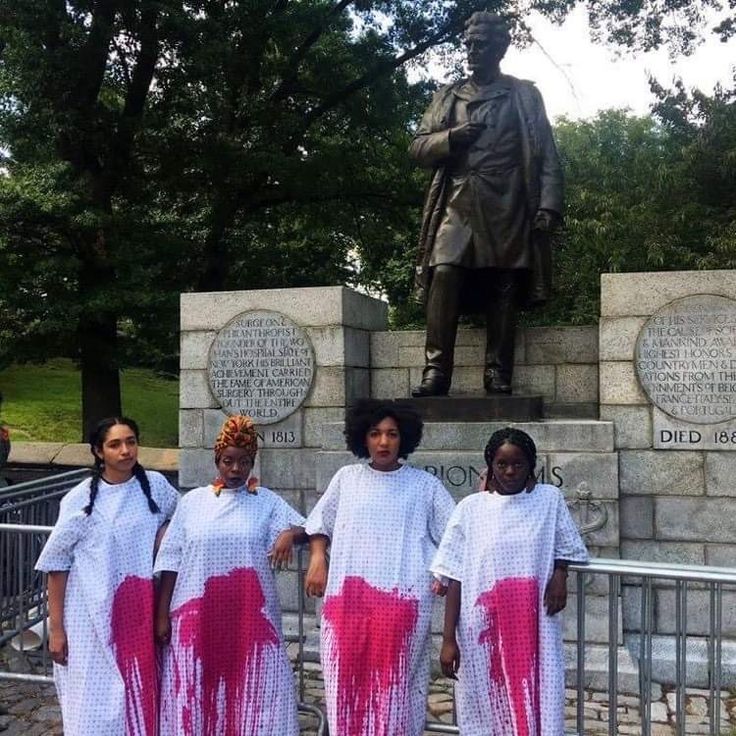
He developed a surgical technique that aided obstructed childbirth. Sims was also elected as president of the American Medical Society in 1876. However, his ethics and the way he was able to reach these heights in the medical field were horrific. Sims practised and perfected his techniques through non-consensual and unanaesthetised surgeries on enslaved Black women. The sacrifices and contributions these women made to the field cannot be understated. The unimaginable pain these women endured for Sims to make his breakthrough has caused him to be a controversial historical figure. It also brings to light how the bodies of Black women have always been seen as disposable, then and even today in the medical field. I want to highlight the women we know of who went through the unimaginable at the hands of John Marion Sims, and from records, we know the names of some of these women: Anarcha Westcott, Lucy and Betsy. Due to the work of many historians and those re-examining history through the lens of medicine, the stories of these women have come to light, and Anarcha Westcott has been rightly dubbed the “Mother of modern gynaecology’ due to the many surgeries she endured that led to Sims' breakthrough.
The legacy of medical racism did not begin with a single doctor, a single law, or a single horrific case. It is the accumulated weight of centuries of violence, exploitation, and dehumanisation. From the plantations where enslaved Black women were treated as vessels for labour and experimentation, to modern hospitals where their pain is still questioned and their lives still undervalued, the through-line is unmistakable. The stories of Anarcha Westcott, Lucy, Betsy, and countless unnamed women are not distant footnotes; they are the blueprint upon which today’s inequities were built. And cases like Adriana Smith remind us that the same logic that once allowed doctors to cut into Black women without consent continues to echo in the systems that deny them autonomy, dignity, and protection.
Understanding this history forces us to confront an uncomfortable truth. The disparities Black women face in healthcare today are not anomalies or accidents - they are the predictable outcomes of a system never designed with their humanity in mind. If medical racism was constructed through centuries of policy, practice, and pseudoscience, then dismantling it requires more than awareness. It demands accountability, structural reform, and a reimagining of medicine grounded in justice.
By revisiting the past, we do not do so to reopen wounds, but to name them to expose the roots of a system that still harms, and to insist that the bodies and experiences of Black women are no longer sites of neglect or exploitation. Only by acknowledging this painful lineage can we begin to create a future where Black women’s pain is heard, their autonomy respected, and their lives valued in full.
By Balia Adare @balialdn
.jpeg)

Subscribe to our newsletter to gain exclusive access to new articles and community initiatives. Stay informed and help us bridge The Science Gap!